
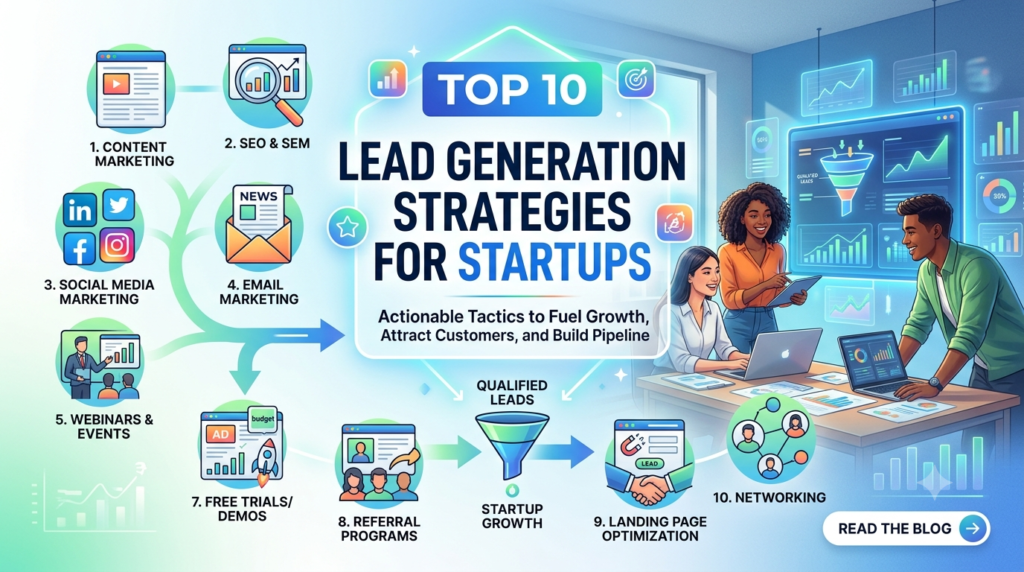
For startups, finding potential customers is one of the most important steps toward building a sustainable business. A great product or service can only grow when the right audience discovers it and becomes interested in what the business offers.
This is where lead generation becomes important.
Lead generation is the process of attracting potential customers and encouraging them to share their contact information or take a meaningful action, such as requesting a consultation, signing up for a service, downloading a resource, or making an enquiry.
Startups often have limited budgets and resources, so their lead generation strategy needs to be focused and measurable. Instead of trying every marketing channel at once, businesses can identify the channels their target customers use and develop a consistent approach around them.
In this article, we explore the top 10 lead generation strategies for startups and explain how businesses can use them to attract prospects and build a stronger sales pipeline.
1. Define Your Ideal Customer
Before generating leads, you need to understand who you want to attract.
Create an ideal customer profile based on factors such as:
- Industry
- Location
- Age or business size
- Job role
- Needs and challenges
- Budget
- Buying behavior
- Interests
- Decision-making process
For a B2B startup, the ideal customer might be a small or medium-sized business looking for a particular service.
For a consumer startup, the target audience may be defined by demographics, interests, lifestyle, location, and purchasing behavior.
Understanding your ideal customer helps you create more relevant content, advertisements, offers, and landing pages.
Instead of asking, “How can we get more leads?” ask:
“What type of customer is most relevant to our business?”
This provides a stronger foundation for your lead generation strategy.
2. Build a Conversion-Focused Website
Your website is often one of the most important assets for generating leads.
A website should clearly communicate:
- What your business offers
- Who you serve
- The benefits of your product or service
- Why customers should consider you
- How visitors can contact you
Include clear calls to action throughout relevant pages.
Examples include:
- Get Started
- Request a Quote
- Book a Consultation
- Contact Us
- Request a Demo
- Download the Guide
Make sure your website works well on mobile devices and provides a simple user experience.
Avoid overwhelming visitors with too many options. Each important page should have a clear next step.
3. Create Valuable Content
Content marketing can help startups attract people who are researching problems, products, and solutions related to their industry.
Useful content can include:
- Blog posts
- Guides
- Case studies
- Tutorials
- Videos
- Checklists
- Industry reports
- Infographics
- Frequently asked questions
For example, a startup offering digital marketing services could create articles about SEO, Google Ads, social media marketing, website optimization, and lead generation.
The goal is not simply to publish large quantities of content.
Focus on answering real customer questions and providing information that helps your target audience make informed decisions.
High-quality content can also support SEO and provide assets that can be shared through social media, email, and paid campaigns.
4. Use Search Engine Optimization
SEO can help startups attract people who are searching for relevant information, products, and services.
Start by researching keywords that your target customers use.
For example, a startup selling accounting software might target topics related to:
- Accounting software for small businesses
- Small business accounting
- Online accounting software
- Business expense management
Create useful pages and articles around relevant search intent.
Important SEO activities can include:
- Keyword research
- On-page optimization
- Technical SEO
- Internal linking
- Content creation
- Website performance optimization
- Building relevant backlinks
SEO usually requires consistent effort and time. However, it can become an important source of organic traffic and potential leads as your website’s search visibility grows.
5. Run Targeted Google Ads Campaigns
Paid search advertising can help startups reach people who are actively searching for relevant products or services.
Google Ads can be used for objectives such as:
- Lead generation
- Website enquiries
- Phone calls
- Product sales
- Service bookings
- Website traffic
To create a more structured campaign, focus on:
- Relevant keywords
- Search intent
- Compelling ad copy
- Dedicated landing pages
- Negative keywords
- Conversion tracking
- Budget management
For example, someone searching for “digital marketing agency for startups” may have a different intent from someone searching for “digital marketing definition.”
Understanding these differences can help you create more relevant advertising campaigns.
6. Leverage Social Media Marketing
Social media platforms can help startups reach audiences, build awareness, and generate potential customers.
Depending on your target audience, you might use platforms such as:
- YouTube
- X
Create content that educates, informs, entertains, or solves customer problems.
You can also use social media to encourage actions such as:
- Visiting your website
- Sending a message
- Registering for an event
- Downloading a resource
- Requesting information
Consistency is important. Create a content calendar and publish content according to a sustainable schedule.
7. Offer Lead Magnets
A lead magnet is a useful resource offered to potential customers in exchange for their contact information.
Examples include:
- E-books
- Checklists
- Templates
- Guides
- Webinars
- Free reports
- Industry research
- Free consultations
For example, a digital marketing startup could offer a “Startup Digital Marketing Checklist” in exchange for an email address.
A good lead magnet should solve a specific problem for your target audience.
Avoid creating a resource simply because it sounds attractive. Focus on something that your potential customers genuinely find useful.
8. Use Email Marketing to Nurture Leads
Not every lead is ready to purchase immediately.
Some prospects may need more information before making a decision. Email marketing can help businesses stay connected with these prospects.
A lead-nurturing email sequence might include:
Email 1: Welcome and resource delivery
Email 2: Helpful educational content
Email 3: Common customer challenges
Email 4: Case study or example
Email 5: Product or service information
Email 6: Call to action
The exact sequence should depend on your industry and customer journey.
Personalize communication where appropriate and avoid sending irrelevant or excessive messages.
The goal is to provide useful information while helping prospects understand how your product or service may address their needs.
9. Use Referral and Customer Marketing
Existing customers can become an important source of new business.
Create a customer experience that encourages satisfied customers to recommend your company.
Referral strategies may include:
- Referral programs
- Customer testimonials
- Case studies
- Reviews
- Customer stories
- Referral incentives where appropriate
For B2B startups, a successful customer relationship can also lead to introductions to other businesses.
Always make the referral process simple.
For example, provide customers with an easy way to share your website, service page, or referral information.
10. Measure and Optimize Your Lead Generation
One of the most important lead generation strategies for startups is measuring performance.
Track where your leads are coming from and what happens after they enter your sales funnel.
Important metrics can include:
- Number of leads
- Qualified leads
- Conversion rate
- Cost per lead
- Website conversion rate
- Lead-to-customer rate
- Customer acquisition cost
- Revenue generated
For example, suppose your startup receives leads from SEO, Google Ads, and social media.
Instead of looking only at the number of leads from each channel, compare lead quality and eventual business outcomes.
This can help you understand which channels deserve additional attention and which areas need improvement.
Common Lead Generation Mistakes Startups Should Avoid
Targeting Everyone
Trying to attract everyone can make your marketing message too broad. Define a clear target audience.
Using Weak Calls to Action
Make it obvious what visitors should do next.
Collecting Too Much Information
Long forms can create unnecessary friction. Ask for information that is genuinely needed.
Ignoring Lead Follow-Up
A lead can lose interest if there is a long delay before receiving a response.
Focusing Only on Lead Quantity
A large number of low-quality leads may be less useful than a smaller number of relevant prospects.
Not Tracking Lead Sources
If you do not know where your leads originate, it becomes harder to evaluate your marketing channels.
How to Build a Lead Generation Funnel
A simple startup lead generation funnel can be structured into four stages:
1. Awareness
Potential customers discover your business through SEO, social media, advertising, content, referrals, or other channels.
2. Interest
They visit your website, read your content, watch a video, or interact with your social media content.
3. Lead
They take an action such as completing a form, requesting information, signing up, or booking a consultation.
4. Nurturing and Conversion
You follow up with relevant information and guide qualified prospects through the sales process.
This process can be summarized as:
Attract → Engage → Capture → Nurture → Convert
The exact customer journey will vary depending on the industry and business model.
Benefits of Effective Lead Generation for Startups
A structured lead generation strategy can help startups:
- Build a consistent sales pipeline
- Reach relevant audiences
- Increase brand awareness
- Generate customer enquiries
- Understand customer needs
- Improve marketing measurement
- Support business growth
Lead generation also provides valuable information about your target market. By analyzing questions, objections, and customer behavior, startups can improve their products, services, website, and marketing messages.