
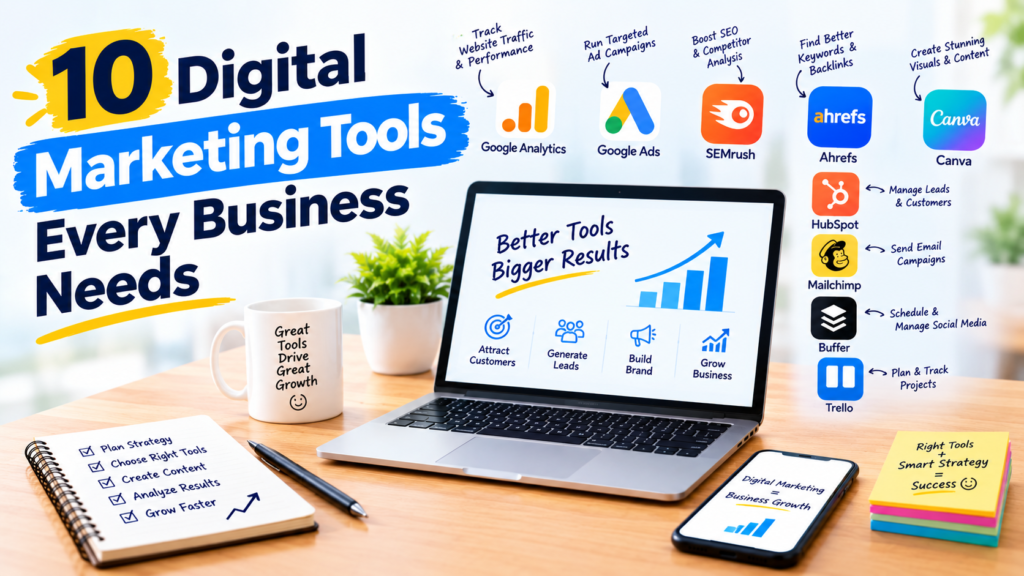
Digital marketing has become an essential part of growing a modern business. Whether you run a startup, small business, e-commerce store, or established company, the right digital marketing tools can help you attract customers, manage campaigns, analyze performance, and improve your online presence.
Managing digital marketing manually can be time-consuming. Businesses need to understand their audience, create content, monitor website performance, optimize search visibility, manage social media, run advertising campaigns, and measure conversions.
This is where digital marketing tools can make a significant difference.
The right tools can help businesses collect useful data, automate repetitive tasks, identify marketing opportunities, and make better-informed decisions. However, businesses do not necessarily need dozens of expensive tools. The goal should be to choose tools that match your objectives, marketing channels, budget, and team capabilities.
In this article, we explore 10 digital marketing tools every business needs and explain how each category can support your marketing strategy.
1. Google Analytics
Understanding how visitors interact with your website is essential for making informed marketing decisions.
Google Analytics is a widely used analytics platform that helps businesses analyze website and app activity.
Businesses can use analytics to understand information such as:
- Website traffic
- User acquisition
- Traffic sources
- User engagement
- Conversions
- Landing-page performance
- Audience behavior
For example, if your website receives traffic from social media but very few visitors complete your enquiry form, analytics data can help you investigate where users are dropping off.
Analytics becomes even more useful when connected with other marketing activities.
Rather than focusing only on traffic volume, businesses should identify which channels contribute to meaningful actions such as leads, purchases, registrations, or enquiries.
2. Google Search Console
If your business depends on organic search traffic, Google Search Console is an important SEO tool.
It provides information about how your website appears in Google Search and can help website owners monitor search performance.
You can use Search Console to analyze:
- Search queries
- Search impressions
- Clicks
- Click-through rates
- Search positions
- Indexed pages
- Website indexing issues
- Search-related technical problems
Search Console can also help identify pages that receive impressions but relatively few clicks.
Businesses can use these insights to improve page titles, content, and SEO strategies.
For websites using WordPress and Rank Math, Search Console can be particularly useful as part of a broader SEO monitoring process.
3. Google Ads
Businesses looking for immediate paid search visibility can use Google Ads.
Google Ads allows businesses to promote products and services across Google’s advertising ecosystem.
Businesses can use paid advertising for objectives such as:
- Lead generation
- Website traffic
- Online sales
- Product promotion
- Service enquiries
- Phone calls
- Brand visibility
Successful advertising requires more than simply creating an advertisement.
Businesses should carefully consider keywords, audience targeting, ad copy, landing pages, budgets, conversion tracking, and campaign optimization.
For startups and small businesses, starting with clear objectives and a controlled budget can help create a more structured advertising process.
4. Meta Business Suite
Businesses using Facebook and Instagram can benefit from tools available through Meta Business Suite.
It provides features for managing aspects of your Facebook and Instagram presence from one place.
Depending on the available features, businesses can use it to:
- Create and schedule content
- Manage messages
- Review notifications
- Monitor content performance
- Manage business accounts
- Support social media workflows
Centralizing social media tasks can save time, particularly for businesses managing multiple social channels.
Businesses should still develop a content strategy before publishing. A tool can simplify execution, but the quality and relevance of the content remain important.
5. Canva
Visual content plays an important role in digital marketing.
Canva is a popular design platform that businesses can use to create marketing materials without requiring advanced graphic design skills.
Businesses can create:
- Social media posts
- Presentations
- Advertisements
- Posters
- Infographics
- Banners
- Marketing graphics
- Basic video content
Templates can help businesses maintain consistent branding across different marketing channels.
However, businesses should customize templates rather than relying entirely on generic designs. Your visuals should reflect your brand identity and communicate your message clearly.
6. Mailchimp
Email marketing remains an important channel for customer communication and retention.
Mailchimp is an email marketing and marketing automation platform that businesses can use for activities such as:
- Email campaigns
- Customer communication
- Audience management
- Automated messages
- Promotional emails
- Newsletters
For example, an e-commerce business can use email marketing to communicate product updates or promotions, while a B2B company can use newsletters to share industry insights.
The effectiveness of email marketing depends heavily on factors such as audience quality, message relevance, subject lines, content, segmentation, and timing.
Avoid sending unnecessary emails. Focus on providing useful and relevant information to subscribers.
7. Semrush
SEO requires research, monitoring, and continuous optimization.
Semrush is a digital marketing platform that provides tools for SEO and other marketing activities.
Businesses can use SEO platforms like Semrush for tasks such as:
- Keyword research
- Competitor research
- Backlink analysis
- Website audits
- Rank tracking
- Content research
- SEO analysis
For example, keyword research can help you discover topics and search terms that are relevant to your target audience.
Competitor research can also provide information about the types of keywords and content being used within your industry.
Businesses should use competitor data as research rather than simply copying another company’s strategy.
8. HubSpot
As businesses grow, managing leads and customer relationships becomes increasingly important.
HubSpot provides tools across areas such as CRM, marketing, sales, and customer service.
Businesses can use CRM and marketing features to help manage:
- Contacts
- Leads
- Customer interactions
- Marketing activities
- Sales pipelines
- Forms
- Email communication
A centralized customer database can make it easier for teams to understand where prospects are within the customer journey.
For businesses generating leads through Google Ads, social media, SEO, or other channels, integrating lead management with marketing processes can help create a more organized workflow.
9. Trello
Digital marketing involves many moving parts.
Your team may need to manage:
- Blog posts
- Social media content
- Advertising campaigns
- SEO tasks
- Email campaigns
- Website updates
- Design projects
A project management tool such as Trello can help organize these activities.
Businesses can create boards, lists, and cards to track marketing tasks through different stages.
For example:
Content Ideas → Writing → Design → Review → Scheduled → Published
This simple workflow can make responsibilities clearer and reduce the risk of important marketing tasks being forgotten.
10. Google Keyword Planner
Keyword research is fundamental to both SEO and paid search advertising.
Google Keyword Planner can help advertisers research keywords and understand potential search demand for relevant terms.
Businesses can use keyword research to discover:
- New keyword ideas
- Related search terms
- Keyword trends
- Estimated search activity
- Advertising-related keyword information
For example, a digital marketing agency might research terms related to SEO, Google Ads, social media marketing, or website development.
Keyword research should always be combined with an understanding of customer intent. A keyword with high search volume is not automatically the most valuable keyword for your business.