
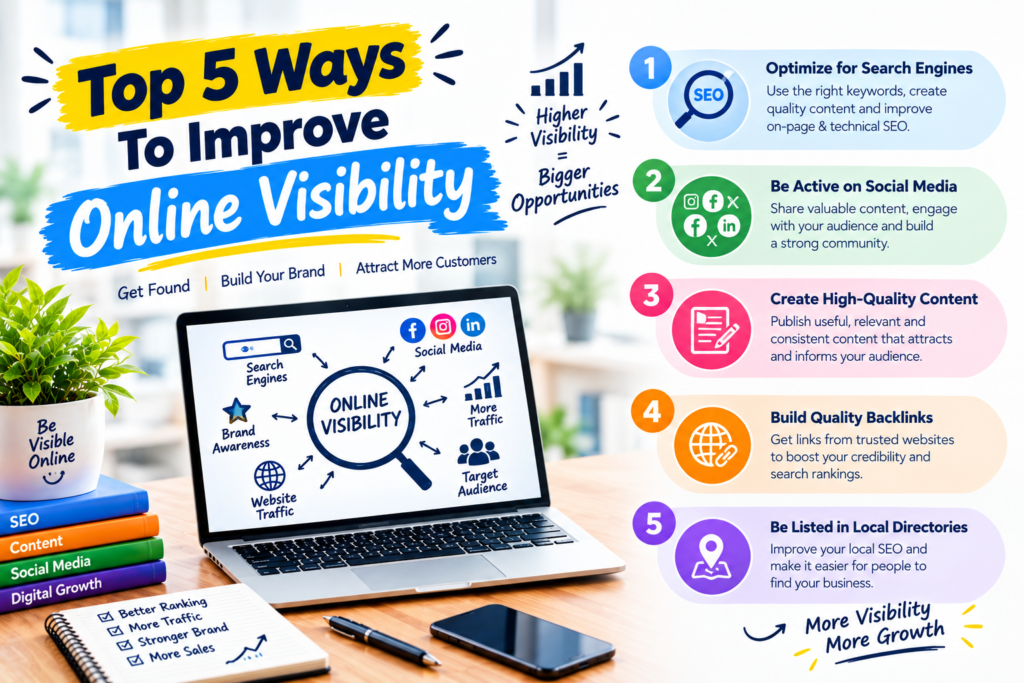
In today’s digital-first marketplace, having a great product or service is only one part of building a successful business. Customers need to be able to find your business online before they can interact with your brand, visit your website, or make a purchase.
This is why improving online visibility has become an important priority for startups, small businesses, and established companies.
Online visibility refers to how easily people can discover your business across search engines, social media platforms, websites, online directories, and other digital channels. A strong online presence can help your business reach potential customers, build brand awareness, generate leads, and support long-term growth.
However, simply creating a website or social media account is not enough. Businesses need a consistent strategy to improve their visibility and connect with the right audience.
In this guide, we explore the top 5 ways to improve online visibility in 2026 and explain how businesses can use these strategies effectively.
Why Is Online Visibility Important?
Before customers contact your business, they may search for information, compare competitors, read reviews, watch videos, or visit your website.
If your business is difficult to find online, you may miss opportunities to connect with potential customers.
Improving online visibility can help businesses:
- Reach more potential customers
- Increase website traffic
- Build brand awareness
- Generate leads
- Improve customer engagement
- Establish online credibility
- Support sales and conversions
- Compete more effectively in the digital marketplace
The goal is not simply to appear everywhere. The goal is to become visible where your target audience is looking.
Top 5 Ways To Improve Online Visibility
1. Invest in Search Engine Optimization (SEO)
One of the most effective ways to improve online visibility is through search engine optimization (SEO).
SEO involves optimizing your website and content so that search engines can better understand and display your pages for relevant searches.
When potential customers search for products, services, or information related to your business, strong SEO can help your website appear in relevant organic search results.
Important SEO Areas
Businesses should focus on:
- Keyword research
- On-page SEO
- Technical SEO
- Internal linking
- Helpful content
- Mobile optimization
- Website speed
- Local SEO
- Relevant backlinks
- Search intent
For example, a digital marketing company targeting startups might create content around searches such as:
“digital marketing services for startups”
“SEO services for small businesses”
“how to improve online visibility”
Instead of targeting every possible keyword, focus on search terms that are relevant to your audience and business objectives.
Create Content Around Search Intent
Understanding search intent is an important part of modern SEO.
If someone searches for “how to improve online visibility,” they are likely looking for information and strategies.
A useful guide can satisfy that informational intent.
On the other hand, someone searching for “digital marketing agency for startups” may be evaluating service providers.
The content and landing page should reflect that commercial intent.
Keep Your Website SEO-Friendly
Make sure your website has:
- Clear page titles
- Useful meta descriptions
- Logical headings
- Descriptive URLs
- Optimized images
- Internal links
- Mobile-friendly design
- Fast-loading pages
SEO is generally a long-term strategy. Consistent optimization and content development are more useful than relying on short-term tactics.
2. Create Valuable and Consistent Content
Content marketing is another effective way to improve online visibility.
Useful content gives your business opportunities to appear in search results, social media feeds, online discussions, and other digital channels.
Content can include:
- Blog posts
- Guides
- Videos
- Infographics
- Case studies
- FAQs
- Tutorials
- Industry insights
- Social media posts
- Webinars
The most important factor is value.
Instead of creating content simply because you need to publish something, identify questions and problems your target audience has.
For example, a startup marketing agency could create content such as:
- Digital marketing strategies for startups
- SEO tips for small businesses
- Google Ads mistakes to avoid
- Social media marketing ideas
- Lead generation strategies
- Website optimization guides
These topics can attract people who are interested in the problems your business solves.
Follow a Content Calendar
Consistency is easier when you have a plan.
Create a content calendar that identifies:
Topic → Target Keyword → Content Format → Publishing Date → Promotion Channel
You can then repurpose content across multiple platforms.
For example, one detailed blog post can become:
- Short social media posts
- A short-form video
- An infographic
- An email newsletter
- A carousel post
This allows businesses to get more value from each piece of content.
3. Strengthen Your Social Media Presence
Social media can significantly increase the number of places where people can discover your business.
However, being active on every platform is not necessary.
Choose platforms based on where your target audience spends time and the type of content your business can consistently produce.
Depending on your business, useful platforms may include professional networks, visual platforms, video platforms, or other relevant social channels.
Create Content That Encourages Engagement
Consider using:
- Educational posts
- Short-form videos
- Customer stories
- Product demonstrations
- Industry tips
- Behind-the-scenes content
- Frequently asked questions
- Polls and interactive content
Avoid making every post promotional.
A balanced social media strategy should provide useful information, demonstrate expertise, and create opportunities for meaningful interaction.
Optimize Your Social Profiles
Make sure your profiles contain:
- Consistent business name
- Clear description
- Website link
- Contact information
- Relevant keywords where appropriate
- Consistent branding
- Updated business information
Your social profile may be one of the first places a potential customer encounters your business.
4. Focus on Local SEO
If your business serves customers in a particular city, region, or local area, local SEO can be an important part of improving online visibility.
Local searches often include terms such as:
- Near me
- In my city
- Best service in [location]
- [service] near me
Businesses should ensure their local business information is accurate and consistent across relevant online platforms.
Important Local SEO Activities
Consider:
- Optimizing your Google Business Profile
- Maintaining accurate contact information
- Adding appropriate business categories
- Publishing relevant updates
- Encouraging genuine customer reviews
- Creating location-specific website content
- Building relevant local citations
For example, a digital marketing agency serving Pune could create useful content and service pages relevant to businesses in Pune while maintaining accurate local business information.
Customer Reviews Matter
Genuine customer reviews can provide useful information to potential customers and contribute to your online reputation.
Encourage satisfied customers to leave honest feedback and respond professionally to both positive and negative reviews.
Never create fake reviews or manipulate customer feedback.
5. Use Paid Advertising Strategically
Organic strategies such as SEO and content marketing can support long-term visibility, but paid advertising can provide businesses with additional opportunities to reach relevant audiences.
Platforms such as search engines and social networks offer advertising options that can be targeted according to campaign settings and audience characteristics.
Businesses can use paid advertising for:
- Brand awareness
- Website traffic
- Lead generation
- Product promotion
- Event registrations
- Sales
- Remarketing
Create Effective Advertising Campaigns
A successful campaign generally requires alignment between:
Audience → Offer → Ad Creative → Landing Page → Conversion
For example, if an advertisement promotes SEO services, the landing page should clearly explain those services and provide an appropriate next step.
Track Your Advertising Performance
Do not judge campaigns only by impressions or clicks.
Depending on your objective, monitor metrics such as:
- Cost per click
- Click-through rate
- Leads
- Cost per lead
- Conversion rate
- Customer acquisition cost
- Return on advertising spend
Use the data to test and improve your campaigns.
Bonus Strategy: Build a Strong Online Reputation
Online visibility and online reputation work together.
A business may appear prominently online, but customers also want to know whether they can trust the company.
Build credibility by:
- Publishing accurate information
- Sharing genuine customer experiences
- Demonstrating expertise
- Responding professionally to feedback
- Keeping business information updated
- Maintaining consistent branding
Your website should clearly explain who you are, what you offer, and how customers can contact you.
How to Measure Online Visibility
Improving visibility is an ongoing process, so businesses should track performance regularly.
Useful metrics include:
Organic Traffic
Measures visitors arriving through unpaid search results.
Search Impressions
Shows how often your pages appear in search results.
Search Clicks
Shows how many users click your search listings.
Social Reach
Measures how many people see your social media content.
Website Engagement
Includes metrics such as pages viewed, engagement, and other relevant website behavior.
Leads and Conversions
Ultimately, visibility should contribute to meaningful business outcomes.
A business with increasing traffic but no improvement in relevant leads may need to review its targeting, content, website experience, or conversion strategy.
Common Online Visibility Mistakes to Avoid
When trying to improve online visibility, avoid these common mistakes:
Targeting Everyone
Define a clear target audience rather than trying to reach everyone.
Keyword Stuffing
Use keywords naturally and prioritize useful content.
Inconsistent Content
Create a realistic publishing schedule that your team can maintain.
Ignoring Mobile Users
Make sure your website works well on smartphones and tablets.
Buying Fake Reviews
Build your reputation through genuine customer experiences.
Focusing Only on Traffic
Traffic is useful, but qualified leads and conversions are often more meaningful business metrics.