
Starting a business is challenging. Startups need to build brand awareness, reach potential customers, generate leads, and establish a strong online presence while often working with limited budgets and resources.
This is where digital marketing channels for startups become important.
Digital marketing provides businesses with multiple ways to connect with their target audience. From search engines and social media to email marketing and paid advertising, each channel can play a different role in the customer journey.
However, startups do not necessarily need to use every available marketing channel. The right approach is to understand your audience, identify where they spend time online, and focus on channels that support your business objectives.
A well-planned digital marketing strategy can combine multiple channels to attract prospects, build trust, generate leads, and support customer retention.
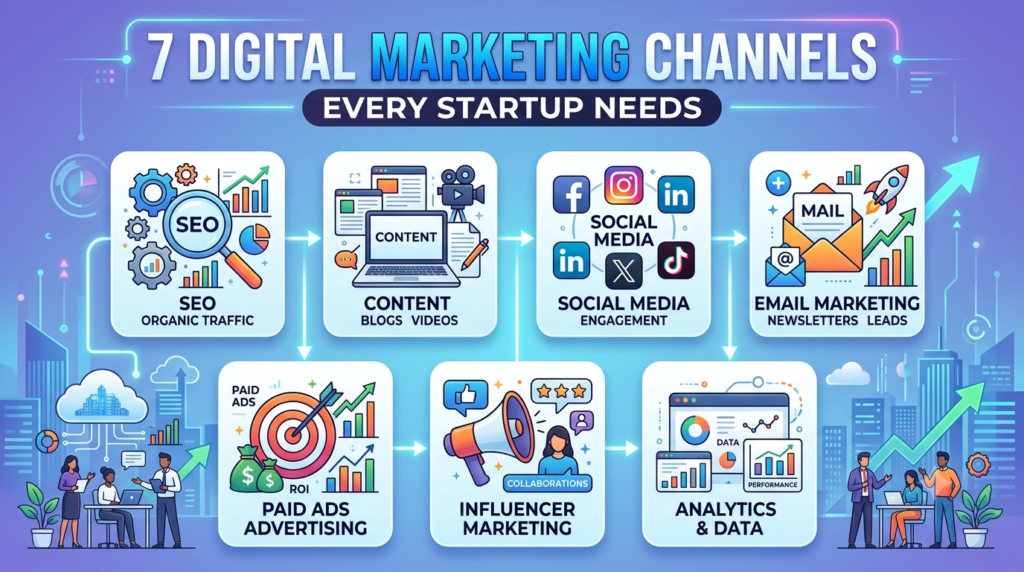
In this article, we explore 7 digital marketing channels every startup needs and explain how each one can contribute to business growth.
1. Search Engine Optimization (SEO)
Search Engine Optimization, commonly known as SEO, is one of the most important digital marketing channels for startups.
SEO focuses on improving a website’s visibility in organic search engine results. When potential customers search for information, products, or services related to your business, effective SEO can help your website appear for relevant searches.
Important SEO activities include:
- Keyword research
- On-page SEO
- Technical SEO
- Content creation
- Internal linking
- Website optimization
- Building relevant backlinks
- Improving user experience
For example, a startup offering accounting software could create content around topics such as small-business accounting, expense management, and accounting software.
SEO can take time to produce meaningful results, but it can become a valuable long-term source of relevant website traffic.
Why Startups Need SEO
SEO can help startups:
- Increase organic visibility
- Attract relevant search traffic
- Build online authority
- Generate potential leads
- Support long-term website growth
Startups should focus on creating useful content that addresses real customer questions rather than simply trying to insert keywords into pages.
2. Google Ads and Paid Search Advertising
While SEO focuses on organic visibility, Google Ads allows businesses to gain paid visibility across Google’s advertising ecosystem.
For startups, paid search can be useful when potential customers are already searching for products or services similar to what the business offers.
Google Ads campaigns can support objectives such as:
- Lead generation
- Website traffic
- Product sales
- Service enquiries
- Phone calls
- Registrations
A successful paid search campaign requires more than selecting keywords.
Startups should also focus on:
- Search intent
- Relevant ad copy
- Landing pages
- Negative keywords
- Conversion tracking
- Budget management
- Campaign optimization
For example, a startup providing digital marketing services may create campaigns around relevant commercial searches such as “digital marketing services for startups.”
Why Startups Need Paid Search
Google Ads can provide startups with an additional way to reach people actively searching for relevant solutions.
Because advertising costs can vary significantly by industry and keyword competition, startups should establish clear objectives and monitor performance carefully.
3. Social Media Marketing
Social media is another important digital marketing channel for startups.
Platforms such as Instagram, Facebook, LinkedIn, YouTube, and other networks allow businesses to communicate directly with audiences and build brand awareness.
Startups can use social media to share:
- Educational content
- Product information
- Short videos
- Customer stories
- Industry insights
- Behind-the-scenes content
- Company updates
- Tips and tutorials
The right platform depends on your target audience and business model.
For example, a B2B startup may find professional audiences on LinkedIn, while a visually focused consumer brand may use Instagram and short-form video platforms.
Why Startups Need Social Media
Social media can help startups:
- Build brand awareness
- Communicate with customers
- Share valuable content
- Generate website traffic
- Support lead generation
- Develop a brand community
Consistency is important. Instead of trying to publish everywhere, choose the platforms that are most relevant to your audience and maintain a sustainable content schedule.
4. Content Marketing
Content marketing focuses on creating and distributing useful, relevant content for your target audience.
For startups, content can be a powerful way to demonstrate expertise and answer potential customers’ questions.
Content marketing can include:
- Blog articles
- Guides
- Case studies
- Videos
- E-books
- Checklists
- Infographics
- Webinars
- Tutorials
- Frequently asked questions
For example, a startup selling cybersecurity software could publish articles explaining common security risks, best practices, and solutions for businesses.
Content marketing can support multiple channels simultaneously. A blog article can be optimized for SEO, shared on social media, included in an email newsletter, and used as a resource in sales conversations.
Why Startups Need Content Marketing
Good content can help startups:
- Educate potential customers
- Build trust
- Support SEO
- Generate organic traffic
- Answer customer questions
- Support lead generation
Focus on quality and usefulness rather than publishing content simply to meet a posting target.
5. Email Marketing
Email marketing allows startups to communicate directly with people who have voluntarily provided their email address.
It can be used throughout the customer journey, from initial lead nurturing to customer retention.
Businesses can send:
- Newsletters
- Educational content
- Product updates
- Promotional messages
- Event invitations
- Welcome emails
- Customer resources
For example, a startup can offer a useful downloadable guide in exchange for an email address and then provide a series of relevant educational emails.
Email marketing can help businesses maintain communication with prospects who are not yet ready to make a purchase.
Why Startups Need Email Marketing
Email marketing can support:
- Lead nurturing
- Customer communication
- Repeat purchases
- Product education
- Customer retention
The quality and relevance of your email list are important. Avoid sending excessive or irrelevant messages.
6. Influencer and Partnership Marketing
Startups can also use partnerships and influencer marketing to reach established audiences.
This strategy involves collaborating with relevant individuals, creators, businesses, communities, or industry partners.
Potential partnership opportunities include:
- Industry influencers
- Content creators
- Complementary businesses
- Professional communities
- Industry publications
- Events and webinars
The most important factor is relevance.
A creator with a large audience is not necessarily the right partner if their audience does not match your target customers.
For example, a startup selling professional productivity software may benefit from partnerships with creators or communities focused on entrepreneurship, business productivity, or professional development.
Why Startups Need Partnerships
Partnership marketing can help businesses:
- Reach new audiences
- Build credibility
- Generate referrals
- Create useful content
- Develop business relationships
Start with partnerships that have a clear connection to your target market and business objectives.
7. Online Reputation and Review Marketing
A startup’s online reputation can influence how potential customers perceive its products and services.
Reviews, testimonials, customer stories, and public feedback can provide additional information for people researching your business.
Startups can encourage genuine customers to share their experiences through appropriate review platforms.
Reputation marketing can include:
- Customer reviews
- Testimonials
- Case studies
- Customer success stories
- Business listings
- Social proof
However, businesses should never create fake reviews or misrepresent customer experiences.
Why Startups Need Reputation Marketing
A positive and transparent online presence can help businesses:
- Build trust
- Address customer concerns
- Showcase customer experiences
- Strengthen brand credibility
- Understand customer feedback
Respond to reviews professionally, including critical feedback. Customer feedback can also reveal opportunities to improve products, services, and customer experiences.
How to Choose the Right Digital Marketing Channels
Startups often have limited resources, so choosing the right channels is important.
Consider the following factors.
1. Identify Your Target Audience
Understand where your potential customers search for information, communicate, and make purchasing decisions.
2. Define Your Business Goals
Your marketing channels should support specific objectives such as:
- Brand awareness
- Website traffic
- Lead generation
- Sales
- Customer retention
3. Consider Your Budget
Some channels require advertising spend, while others primarily require time and content resources.
Create a budget based on your business objectives and available resources.
4. Measure Performance
Track meaningful metrics such as:
- Website traffic
- Leads
- Conversions
- Cost per lead
- Customer acquisition cost
- Engagement
- Revenue
Use performance data to understand which channels are contributing to your goals.
How Digital Marketing Channels Work Together
The seven channels discussed above do not need to operate independently.
A startup can create an integrated marketing system.
For example:
SEO attracts organic search visitors.
Content Marketing provides useful information.
Google Ads reaches people searching for relevant solutions.
Social Media distributes content and builds engagement.
Email Marketing nurtures leads.
Partnership Marketing introduces the brand to new audiences.
Reviews and Reputation Marketing provide social proof.
This creates a connected customer journey:
Discover → Learn → Engage → Consider → Convert → Retain
An integrated approach can help startups create a more consistent digital marketing experience.