
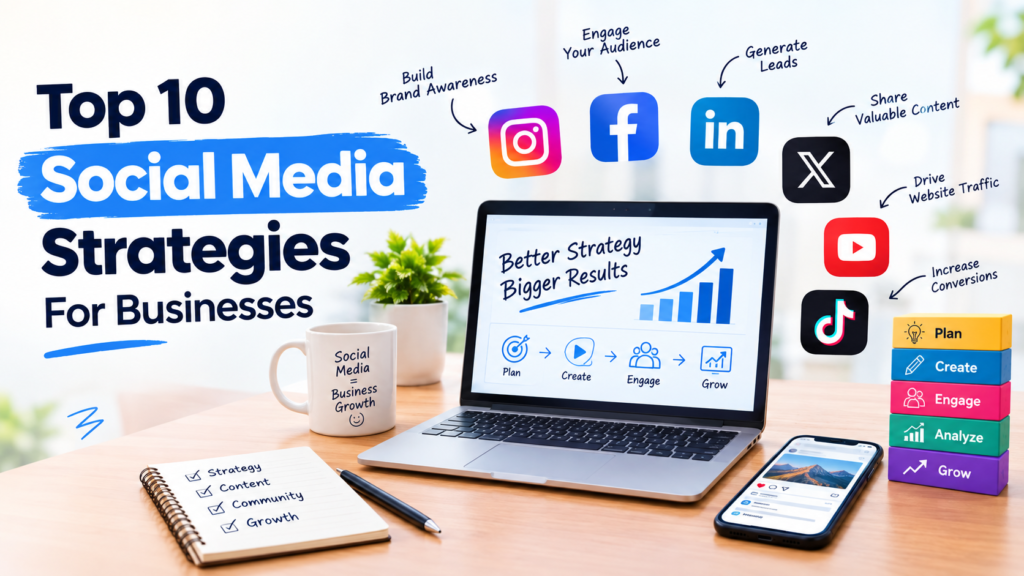
Social media has become an important part of modern digital marketing. Businesses of all sizes use platforms such as Facebook, Instagram, LinkedIn, YouTube, and other social networks to connect with audiences, promote their products and services, and build long-term customer relationships.
However, simply creating social media accounts is not enough. Businesses need a clear strategy to attract the right audience, publish valuable content, maintain consistent communication, and measure performance.
A well-planned social media strategy can help businesses improve brand visibility, engage potential customers, generate leads, and support sales. Whether you are a startup, small business, or established company, having a structured approach can make your social media marketing more effective.
In this blog, we will explore the top 10 social media strategies for businesses and explain how you can use them to strengthen your online presence.
1. Define Clear Social Media Goals
Before posting content, define what you want to achieve through social media.
Your goals may include:
- Increasing brand awareness
- Generating leads
- Driving website traffic
- Increasing sales
- Building a community
- Improving customer engagement
- Promoting products or services
- Increasing customer retention
Your goals should be specific and measurable where possible.
For example, instead of saying “increase social media engagement,” a business could aim to increase meaningful interactions with its target audience over a defined period.
Clear goals help you decide what content to create and which performance metrics to monitor.
2. Understand Your Target Audience
One of the most important social media strategies for businesses is understanding their target audience.
Before creating content, identify:
- Age group
- Location
- Interests
- Professional background
- Common challenges
- Buying behavior
- Preferred social media platforms
- Content preferences
Understanding your audience allows you to create content that addresses their needs and interests.
For example, a B2B company may focus more heavily on professional and educational content, while a fashion business may rely more on visual content.
Do not try to create content for everyone. Define your ideal customer and build your social media strategy around that audience.
3. Choose the Right Social Media Platforms
Businesses do not necessarily need to be active on every social media platform.
Choose platforms based on where your target audience spends time and where your content format performs naturally.
Popular platforms include:
- YouTube
- X
- Other relevant industry-specific platforms
For example, LinkedIn can be useful for B2B companies, professional services, and recruitment, while Instagram can be valuable for businesses that rely heavily on visual content.
Focus on maintaining quality and consistency rather than creating multiple profiles that receive little attention.
4. Create Valuable and Relevant Content
Content is at the center of successful social media marketing.
Businesses should avoid making every post a direct sales pitch. Instead, create content that provides useful information while naturally supporting your business objectives.
Your content can include:
- Educational posts
- How-to guides
- Industry tips
- Product demonstrations
- Customer stories
- Behind-the-scenes content
- Short videos
- Infographics
- Frequently asked questions
- Company updates
A useful content strategy can follow a simple principle:
Educate → Engage → Build Trust → Promote
When audiences consistently receive useful content, they may become more familiar with your brand and offerings.
5. Maintain a Consistent Posting Schedule
Consistency is essential for building an active social media presence.
Create a content calendar that defines:
- What you will publish
- Which platform you will use
- When content will be published
- Who is responsible for creating it
- Which objective each post supports
Your schedule does not need to be complicated.
A simple weekly plan might include:
Monday: Educational content
Wednesday: Engagement post
Friday: Product or service content
Sunday: Brand or community content
The ideal frequency varies by platform and business. The important thing is to establish a sustainable schedule that your team can maintain.
6. Use Visual Content and Short-Form Video
Visual content can help businesses communicate information quickly and make social media posts more engaging.
Consider using:
- Images
- Carousels
- Infographics
- Reels
- Short-form videos
- Product demonstrations
- Tutorials
- Customer testimonials
Short-form video can be particularly useful for explaining products, answering questions, sharing tips, and showcasing company culture.
However, visual quality should support the message rather than replace it. A simple, useful video can be more valuable than an overly complicated piece of content that does not address customer needs.
7. Encourage Audience Engagement
Social media is not just a broadcasting channel. It is also a communication platform.
Encourage your audience to interact with your business by:
- Asking questions
- Creating polls
- Requesting opinions
- Responding to comments
- Answering direct messages
- Encouraging discussions
- Sharing user-generated content
When customers comment on your posts or send messages, respond professionally and within a reasonable timeframe.
Meaningful interactions can help businesses understand customer concerns and identify frequently asked questions that can later become content topics.
8. Use Social Media Advertising
Organic social media content is only one part of a broader strategy. Businesses can also use paid social media advertising to reach specific audiences.
Social advertising can be used for objectives such as:
- Website traffic
- Lead generation
- Product promotion
- Event promotion
- Brand awareness
- Sales
- App promotion
Before launching an advertising campaign, define the audience, objective, offer, creative, and conversion action.
Test different advertisements and monitor their performance.
Paid campaigns should complement your organic social media presence rather than replace it.
9. Track and Analyze Performance
A successful social media strategy should be measurable.
Important metrics can include:
- Reach
- Impressions
- Engagement
- Website clicks
- Follower growth
- Leads
- Conversions
- Video views
- Cost per result for paid campaigns
The most useful metrics depend on your business objectives.
For example, if your primary goal is lead generation, the number and quality of leads may be more important than follower growth.
Review your performance regularly and identify which content formats, topics, platforms, and campaigns are producing meaningful results.
Use these insights to improve your future content strategy.
10. Continuously Test and Improve Your Strategy
Social media trends, audience behavior, and platform features change regularly. Businesses should therefore treat social media marketing as an ongoing process.
Test different:
- Content formats
- Topics
- Headlines
- Visual designs
- Calls to action
- Posting times
- Video styles
- Advertising audiences
Track the results and use the information to refine your strategy.
Do not assume that a strategy that worked previously will always produce the same results. Regular testing allows businesses to learn what resonates with their current audience.
Common Social Media Marketing Mistakes Businesses Should Avoid
Even a well-planned social media strategy can be affected by common mistakes.
Posting Without a Strategy
Publishing random content without clear objectives can make it difficult to build a consistent brand presence.
Focusing Only on Sales
Constant promotional content can make audiences less interested in following your business.
Ignoring Comments and Messages
Social media users expect businesses to communicate with them. Ignoring questions and feedback can negatively affect the customer experience.
Inconsistent Branding
Use consistent brand messaging, visuals, tone, and information across your social media profiles.
Buying Fake Followers
Follower numbers alone do not guarantee meaningful engagement or business results. Focus on building a relevant and genuine audience.
Not Measuring Results
Without analytics, it becomes difficult to understand what is working and where improvements are needed.
Benefits of Social Media Marketing for Businesses
A structured social media strategy can support several areas of business marketing.
Increased Brand Awareness
Regular, useful content can help more people discover and become familiar with your business.
Customer Engagement
Social media provides opportunities for businesses to communicate directly with their audiences.
Lead Generation
Businesses can use organic content, paid campaigns, landing pages, and lead forms to generate enquiries.
Website Traffic
Social posts can direct interested users to relevant website pages, blogs, products, or services.
Customer Insights
Comments, messages, engagement data, and social listening can provide useful information about customer interests and questions.
Brand Trust
Consistent communication, useful content, and transparent customer interactions can contribute to a stronger online brand presence.
How to Create a Social Media Strategy
Creating a social media strategy does not have to be complicated.
Start by defining your business goals and identifying your target audience. Then choose the platforms that are most relevant to your customers.
Create a content calendar and develop a mixture of educational, engaging, informative, and promotional content.
Publish consistently, respond to your audience, and track important performance metrics.
Finally, review your results and make improvements based on the data.
A simple process is:
Research → Plan → Create → Publish → Engage → Measure → Optimize
Following this process can help businesses build a more organized and sustainable social media marketing system.
Conclusion
Social media can be a powerful channel for businesses looking to build brand awareness, connect with customers, generate leads, and strengthen their online presence.
The top 10 social media strategies for businesses include setting clear goals, understanding your audience, selecting the right platforms, creating valuable content, maintaining consistency, using visual content, encouraging engagement, using social media advertising, analyzing performance, and continuously improving your strategy.
The key is to focus on your audience rather than simply chasing follower numbers. Create useful content, communicate consistently, measure meaningful results, and adjust your approach as your business and audience evolve.
For businesses that want to build a stronger digital presence, social media can work alongside other channels such as SEO, Google Ads, content marketing, and email marketing.
Skillsk provides digital marketing solutions for startups and businesses looking to improve their online presence. A well-planned combination of social media marketing and other digital channels can help businesses create a more consistent and measurable marketing strategy.
Ready to strengthen your social media presence? Connect with Skillsk and explore digital marketing solutions designed for your business.