
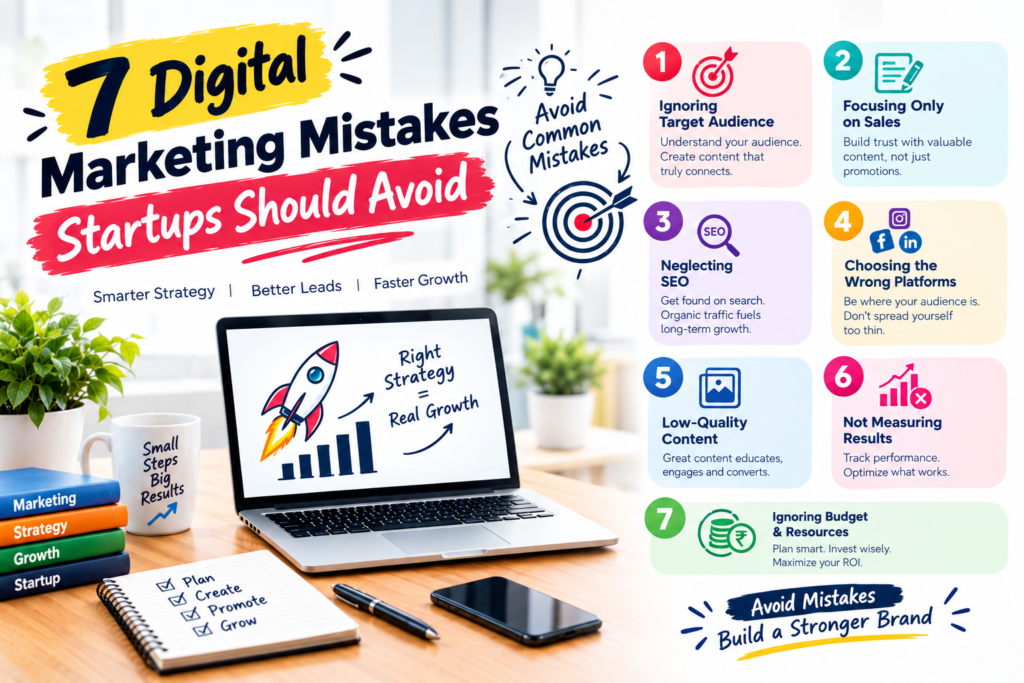
Starting a new business is exciting, but building a successful brand in today’s competitive digital environment can be challenging. Startups need to attract customers, build brand awareness, generate leads, and establish credibility—often with limited budgets and small teams.
Digital marketing can help startups achieve these goals, but an ineffective strategy can waste valuable time and money. From targeting the wrong audience to ignoring SEO and failing to measure campaign performance, common marketing mistakes can prevent a startup from reaching its growth potential.
Understanding these mistakes before they happen can help businesses create a more focused and sustainable marketing strategy.
In this blog, we discuss 7 digital marketing mistakes startups should avoid and explain practical ways to improve your approach.
Why Digital Marketing Is Important for Startups
Most customers research businesses online before making purchasing decisions. Your website, search engine presence, social media profiles, advertisements, reviews, and content can all influence how potential customers perceive your business.
A strong digital marketing strategy can help startups:
- Increase brand awareness
- Reach relevant audiences
- Generate qualified leads
- Build customer trust
- Increase website traffic
- Improve online visibility
- Support sales growth
- Build long-term customer relationships
However, successful digital marketing requires planning and consistent execution.
7 Digital Marketing Mistakes Startups Should Avoid
1. Not Defining a Clear Target Audience
One of the most common digital marketing mistakes startups make is trying to market to everyone.
When a business does not clearly understand its target audience, its messaging can become too generic. As a result, marketing campaigns may attract people who are unlikely to become customers.
Before launching a campaign, define your ideal customer.
Consider factors such as:
- Age group
- Location
- Industry
- Job role
- Interests
- Buying behavior
- Problems and challenges
- Budget
- Purchase motivation
For example, a startup providing digital marketing services to businesses may target early-stage companies, established enterprises, local businesses, or specific industries.
Each audience may require different messaging and marketing channels.
How to Avoid This Mistake
Create detailed customer profiles and identify the problems your product or service solves. Use this information to develop targeted campaigns and content.
The more clearly you understand your audience, the easier it becomes to communicate your value proposition.
2. Ignoring SEO
Another major mistake is treating SEO as something that can be addressed later.
Search engine optimization can help startups attract people who are actively searching for relevant products, services, and information.
Without SEO, a business may miss opportunities to generate organic traffic.
Startups should focus on essential SEO activities such as:
- Keyword research
- On-page optimization
- Technical SEO
- Content creation
- Internal linking
- Mobile optimization
- Local SEO
- Website performance
- Relevant backlinks
Why SEO Matters
Paid advertising can provide visibility while campaigns are running, but SEO can help build long-term organic visibility.
Startups should begin optimizing their websites early rather than waiting until their business has already grown.
How to Avoid This Mistake
Create an SEO strategy based on your audience and business goals. Identify relevant search terms, optimize important pages, and consistently publish useful content.
3. Being Active on Every Social Media Platform
Social media can be extremely useful for startups, but trying to maintain a presence on every platform can spread resources too thin.
Different platforms attract different audiences and content formats.
For example, a B2B startup may prioritize professional networking platforms and industry-focused content, while a consumer brand may invest more heavily in visual and short-form video platforms.
The goal should not be to be everywhere.
The goal should be to be where your target customers are.
How to Avoid This Mistake
Choose two or three platforms that align with your audience and business objectives.
Develop a consistent content strategy and focus on creating useful, engaging content rather than posting simply to remain active.
Track performance and adjust your platform strategy based on actual results.
4. Focusing on Quantity Instead of Quality
Some startups believe that publishing more content automatically produces better marketing results.
This can lead to large amounts of repetitive, shallow, or low-value content.
Whether it is blog articles, social media posts, videos, or emails, quality should remain a priority.
Good content should:
- Answer customer questions
- Solve problems
- Provide useful information
- Demonstrate expertise
- Match search intent
- Be easy to understand
- Encourage meaningful action
For example, instead of publishing five generic articles about SEO, a startup could create one comprehensive guide covering keyword research, technical SEO, on-page optimization, content strategy, and measurement.
How to Avoid This Mistake
Create a content calendar based on customer needs. Research topics carefully and prioritize content that provides genuine value.
Consistency matters, but publishing useful content is more important than simply increasing publishing frequency.
5. Running Paid Ads Without a Clear Strategy
Paid advertising can help startups reach potential customers quickly, but running advertisements without proper planning can result in wasted budget.
Common problems include:
- Poor audience targeting
- Weak ad messaging
- Incorrect campaign objectives
- Poor landing pages
- No conversion tracking
- Inadequate testing
- Failing to analyze results
Simply increasing the advertising budget does not guarantee better results.
How to Avoid This Mistake
Before launching an advertising campaign, define:
Campaign Goal → Target Audience → Offer → Ad Creative → Landing Page → Conversion Tracking
Test different headlines, visuals, audiences, and calls to action where appropriate.
Most importantly, track conversions rather than focusing only on clicks or impressions.
6. Ignoring Data and Analytics
Another important digital marketing mistake startups should avoid is making decisions based entirely on assumptions.
Marketing performance should be measured using reliable data.
Important metrics may include:
- Website traffic
- Organic search traffic
- Leads
- Conversion rate
- Cost per lead
- Customer acquisition cost
- Click-through rate
- Engagement
- Return on advertising spend
The right metrics depend on the business model and marketing objective.
For example, a campaign designed for brand awareness may focus on reach and engagement, while a lead generation campaign should pay closer attention to leads and conversion rates.
How to Avoid This Mistake
Set measurable objectives before launching campaigns.
Review performance regularly and identify which channels, campaigns, and content pieces are contributing to business goals.
Data should guide optimization decisions rather than assumptions.
7. Expecting Instant Results
One of the biggest challenges for startups is expecting digital marketing to produce immediate results.
Some channels can generate results relatively quickly, particularly paid advertising, while strategies such as SEO, content marketing, and organic social media often require consistent effort over time.
A startup may publish a few blog posts or run a small advertising campaign and expect significant revenue immediately. When that does not happen, the business may abandon the strategy before there is enough information to evaluate it properly.
How to Avoid This Mistake
Set realistic timelines and establish measurable milestones.
Instead of asking only, “Did we get sales immediately?” evaluate progress through indicators such as:
- Increasing website traffic
- Growing search visibility
- Improved engagement
- More qualified leads
- Better conversion rates
- Increasing brand awareness
Digital marketing should be treated as an ongoing process of testing, learning, and optimization.
Bonus: Avoid Inconsistent Branding
Although not one of the seven primary mistakes, inconsistent branding can also create challenges for startups.
Your website, social media profiles, advertisements, emails, and other marketing materials should communicate a consistent identity.
Maintain consistency in:
- Logo usage
- Colors
- Typography
- Brand voice
- Messaging
- Visual style
- Value proposition
A consistent brand can make it easier for customers to recognize and remember your business.
How Startups Can Build a Better Digital Marketing Strategy
Avoiding mistakes is only the first step. Startups also need a clear marketing framework.
Step 1: Define Your Goals
Determine whether your primary objective is brand awareness, website traffic, lead generation, sales, or customer retention.
Step 2: Understand Your Audience
Research your customers, their challenges, preferences, and online behavior.
Step 3: Select the Right Channels
Choose marketing channels based on your audience and objectives rather than following trends blindly.
Step 4: Create Valuable Content
Develop content that answers customer questions and demonstrates your expertise.
Step 5: Optimize for Search
Build a strong SEO foundation to improve organic visibility.
Step 6: Track Performance
Use relevant metrics to understand campaign effectiveness.
Step 7: Improve Continuously
Test different strategies, learn from the results, and make data-driven adjustments