
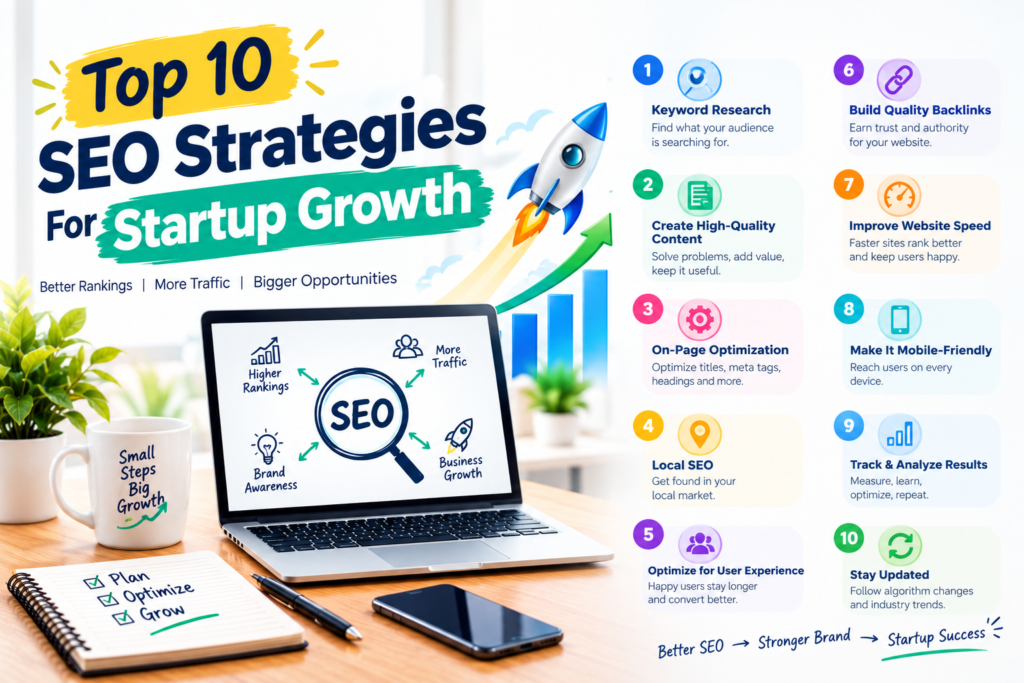
For startups, building a strong online presence is essential for attracting customers and competing with established businesses. While paid advertising can deliver immediate visibility, search engine optimization (SEO) can help startups generate consistent organic traffic over the long term.
A well-planned SEO strategy can help your startup appear when potential customers search for products, services, or solutions related to your business. However, SEO is more than simply adding keywords to a website. It involves content creation, technical optimization, user experience, authority building, and understanding search intent.
In this guide, we explore the top 10 SEO strategies for startup growth in 2026 and explain how startups can use them to increase website visibility, attract qualified visitors, generate leads, and build long-term digital growth.
Why SEO Is Important for Startup Growth
Startups often operate with limited budgets and resources. SEO provides an opportunity to build visibility without depending entirely on continuous advertising expenditure.
A strong SEO strategy can help startups:
- Increase organic website traffic
- Improve search engine visibility
- Reach potential customers
- Generate qualified leads
- Build brand credibility
- Reduce dependence on paid advertising
- Improve website usability
- Create long-term marketing assets
SEO generally takes time, so startups should approach it as a long-term growth strategy rather than expecting instant results.
Top 10 SEO Strategies For Startup Growth
1. Conduct Thorough Keyword Research
Keyword research should be the foundation of your startup SEO strategy.
Keywords are the terms and phrases people enter into search engines when looking for information, products, or services. Identifying relevant keywords helps you understand what your target audience is searching for.
Instead of targeting only highly competitive keywords, startups can also focus on specific long-tail keywords.
For example, rather than targeting a broad term such as “digital marketing,” a startup could target more specific phrases such as:
- Digital marketing services for startups
- Affordable SEO services for small businesses
- SEO agency for startup companies
- Digital marketing strategies for new businesses
How to Perform Keyword Research
Identify keywords based on:
- Search intent
- Relevance to your business
- Competition
- Search demand
- Customer problems
- Commercial intent
Create a keyword list and organize keywords according to different website pages and content topics.
2. Optimize Your Website for On-Page SEO
On-page SEO involves optimizing elements within your website to help search engines understand your content.
Important on-page SEO elements include:
- SEO title
- Meta description
- URL structure
- Headings
- Keyword placement
- Image alt text
- Internal links
- Content structure
Your primary keyword should appear naturally in important areas without keyword stuffing.
For example, if your target keyword is “SEO strategies for startup growth,” it can be included in the page title, introduction, relevant headings, URL, and naturally throughout the content.
The goal is to make the page useful for readers first while making its topic clear to search engines.
3. Create High-Quality, Helpful Content
Content marketing and SEO work closely together.
Search engines aim to provide users with useful and relevant information. Startups can build organic visibility by consistently publishing content that answers their audience’s questions and solves real problems.
Consider creating:
- Blog posts
- Guides
- Tutorials
- Case studies
- Industry reports
- FAQs
- Comparison pages
- Service pages
For example, a startup offering accounting software could create content around topics such as small-business accounting, invoicing, tax preparation, bookkeeping, and financial management.
Focus on Search Intent
Before creating content, understand why someone is searching for a particular keyword.
Search intent can generally include:
Informational: The user wants information.
Navigational: The user wants to find a specific website or brand.
Commercial: The user is researching a product or service.
Transactional: The user is ready to take an action or make a purchase.
Matching content with search intent can make your pages more useful and relevant.
4. Build a Strong Internal Linking Strategy
Internal links connect one page of your website to another page on the same website.
A strong internal linking structure helps visitors discover additional content and helps search engines understand the relationship between pages.
For example, a blog about SEO strategies for startups could internally link to related articles about:
- Keyword research
- Technical SEO
- Local SEO
- Content marketing
- Link building
- Website optimization
Use descriptive anchor text that clearly indicates what the linked page is about.
Internal linking can also help distribute authority throughout your website and improve navigation.
5. Improve Technical SEO
Technical SEO focuses on the technical aspects of your website that affect crawling, indexing, performance, and usability.
Startups should regularly review:
- Website speed
- Mobile responsiveness
- XML sitemap
- Robots.txt
- HTTPS security
- Broken links
- Redirects
- Canonical URLs
- Indexing issues
- Website architecture
A technically healthy website gives search engines a clearer understanding of your content and provides visitors with a better experience.
Make sure important pages can be crawled and indexed properly.
6. Make Your Website Mobile-Friendly
A large portion of internet activity takes place on mobile devices. Therefore, startups should ensure their websites provide a smooth experience across smartphones, tablets, and desktop computers.
A mobile-friendly website should have:
- Responsive design
- Easy-to-read text
- Simple navigation
- Fast loading times
- Mobile-friendly buttons
- Properly sized images
- Easy-to-use forms
Test your website regularly on different screen sizes.
A website that is difficult to use on mobile devices can negatively affect user experience and conversions, even if the content itself is strong.
7. Focus on Local SEO
For startups serving customers in specific cities or regions, local SEO can be particularly valuable.
Local SEO helps businesses improve their visibility for searches with local intent.
For example:
“Digital marketing agency near me”
or
“SEO services in Pune.”
Startups should maintain accurate business information across relevant online platforms and create location-specific content where appropriate.
Local SEO activities can include:
- Optimizing your Google Business Profile
- Maintaining consistent business information
- Collecting genuine customer reviews
- Creating local landing pages
- Publishing locally relevant content
- Building relevant local citations
For service-based startups, local SEO can help connect the business with customers searching for nearby services.
8. Build High-Quality Backlinks
Backlinks are links from other websites to your website. They can help search engines understand the authority and relevance of your website.
However, quality is more important than quantity.
Startups can earn relevant backlinks through:
- Guest contributions
- Digital PR
- Industry partnerships
- Original research
- Useful resources
- Expert interviews
- Business directories
- Data-driven content
Avoid relying on spammy link-building practices or purchasing large numbers of low-quality links.
The best backlinks are generally relevant, editorially earned, and connected to genuinely useful content.
9. Optimize Content for Search Experience
Modern SEO requires businesses to think beyond traditional keyword rankings.
Your content should be easy to scan, understand, and navigate.
Use:
- Short paragraphs
- Descriptive headings
- Bullet points
- Tables where useful
- Relevant images
- Examples
- FAQs
- Clear calls to action
Answer important questions directly and avoid unnecessary filler.
You can also update older articles with new information, examples, statistics, and improved structure.
Regular content optimization can help keep your website useful as search behavior and industry information change.
10. Measure SEO Performance and Improve Continuously
SEO should be treated as an ongoing process.
Publishing content and waiting for rankings is not enough. Startups should regularly analyze performance to understand what is working and what needs improvement.
Important SEO metrics include:
- Organic traffic
- Search impressions
- Click-through rate
- Keyword visibility
- Conversion rate
- Leads generated
- Engagement
- Indexed pages
- Backlink growth
Use analytics and search performance tools to identify opportunities.
For example, if a page receives many impressions but relatively few clicks, you may want to review its title and meta description. If a page gets traffic but does not generate leads, examine its content, user experience, and calls to action.
Common SEO Mistakes Startups Should Avoid
While implementing SEO strategies for startup growth, avoid these common mistakes:
Keyword Stuffing
Repeating keywords excessively can make content difficult to read and may create a poor user experience.
Publishing Low-Quality Content
Publishing large quantities of shallow content is not a substitute for creating genuinely useful resources.
Ignoring Technical SEO
Excellent content cannot reach its full potential if important pages cannot be properly crawled or indexed.
Buying Spammy Backlinks
Low-quality link-building tactics can create risks and rarely provide sustainable value.
Expecting Instant Results
SEO generally requires consistent effort and time. Startups should establish realistic expectations and track progress over months rather than days.
How Startups Can Create an Effective SEO Plan
A practical startup SEO plan can follow these steps:
Step 1: Define your target audience.
Step 2: Research relevant keywords.
Step 3: Optimize existing website pages.
Step 4: Create useful content around customer needs.
Step 5: Improve technical SEO.
Step 6: Build internal links.
Step 7: Earn relevant backlinks.
Step 8: Strengthen local SEO if applicable.
Step 9: Monitor SEO performance.
Step 10: Continuously update and improve your strategy.
This process allows startups to build SEO systematically instead of making random changes.