
The digital landscape is changing faster than ever. New technologies, changing customer behavior, and increasing online competition are transforming how businesses attract, engage, and retain customers. For companies that want to remain competitive, understanding the latest digital marketing trends is no longer optional.
From artificial intelligence and personalized marketing to short-form video and search optimization, businesses have more opportunities than ever to connect with their target audience. However, using every new platform or technology is not always the right strategy. Businesses need to identify trends that can deliver meaningful results and align them with their marketing goals.
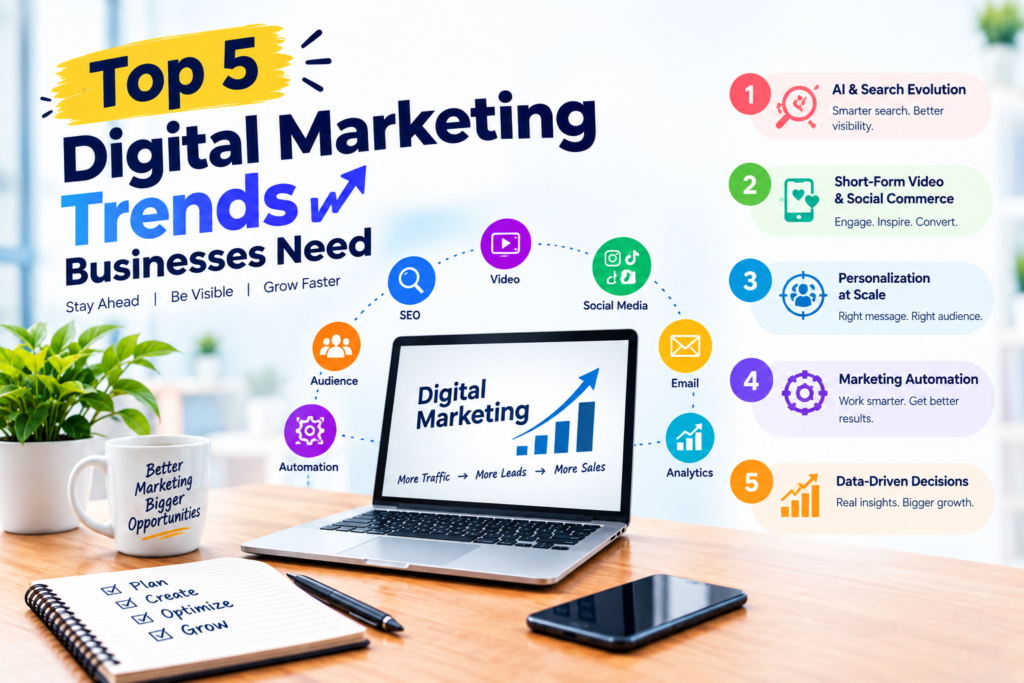
In this blog, we explore the top 5 digital marketing trends businesses need in 2026 and explain how companies can use them to improve brand visibility, generate leads, and grow online.
Why Digital Marketing Trends Matter for Businesses
Consumer behavior is constantly evolving. People use search engines, social media, video platforms, online communities, and AI-powered tools to discover information and make purchasing decisions.
As a result, businesses need to continuously adapt their digital marketing strategies.
Following current digital marketing trends can help businesses:
- Increase online visibility
- Reach targeted audiences
- Generate qualified leads
- Improve customer engagement
- Build stronger brand awareness
- Increase website traffic
- Improve conversion rates
- Stay competitive in their industry
The key is not simply following trends but understanding which trends can create value for your business.
Top 5 Digital Marketing Trends Businesses Need
1. Artificial Intelligence in Digital Marketing
Artificial intelligence has become one of the most important developments in digital marketing. Businesses are increasingly using AI-powered tools to analyze data, create content, understand customers, automate repetitive tasks, and improve marketing campaigns.
AI can help marketers work more efficiently by identifying patterns in customer behavior and marketing performance. It can also support content creation, audience segmentation, campaign optimization, and customer service.
For example, businesses can use AI to:
- Analyze customer behavior
- Generate content ideas
- Personalize marketing messages
- Automate customer responses
- Identify potential customer segments
- Analyze campaign performance
- Improve advertising efficiency
However, AI should support human creativity rather than completely replace it. High-quality marketing still requires brand understanding, originality, strategy, and human judgment.
How Businesses Can Use AI
Start by identifying repetitive marketing tasks that can be automated. Use AI for research, brainstorming, data analysis, personalization, and workflow automation while maintaining human oversight.
Businesses that combine AI technology with a strong marketing strategy can improve productivity while delivering more relevant customer experiences.
2. Short-Form Video Marketing
Video continues to be a powerful way for businesses to communicate with audiences. Short-form videos are particularly useful for capturing attention and communicating information quickly.
Platforms such as Instagram, YouTube, and other social networks have made short videos an important part of modern content strategies.
Businesses can use short-form videos to showcase:
- Products and services
- Customer testimonials
- Behind-the-scenes content
- Educational tips
- Industry insights
- Frequently asked questions
- Product demonstrations
- Company culture
The biggest advantage of short-form video is its ability to communicate a message in a simple and engaging format.
For example, a digital marketing agency can create short videos explaining SEO tips, advertising mistakes, social media strategies, or website optimization techniques.
Tips for Effective Video Marketing
Keep videos focused on one idea. Start with a strong opening, provide useful information, and finish with a clear call to action.
You do not always need expensive equipment. A smartphone, good lighting, clear audio, and useful content can be enough to create effective marketing videos.
3. Search Engine Optimization Beyond Traditional Keywords
SEO remains an important digital marketing strategy, but search behavior is becoming more complex.
Businesses can no longer focus only on inserting keywords into website content. Modern SEO requires a broader approach that focuses on search intent, helpful content, website experience, technical performance, authority, and credibility.
Search engines are becoming better at understanding the context behind queries. Customers may also discover information through different search experiences, including traditional search engines, video platforms, social media, and AI-powered search tools.
Therefore, businesses should create content that genuinely answers customer questions.
Important SEO Areas for Businesses
A modern SEO strategy should consider:
- Search intent
- Helpful and original content
- On-page SEO
- Technical SEO
- Internal linking
- Website speed
- Mobile usability
- Local SEO
- Quality backlinks
- Structured content
- User experience
Businesses should also build content around topics rather than creating isolated pages for individual keywords.
For example, a company offering digital marketing services could create a content cluster covering SEO, social media marketing, Google Ads, content marketing, email marketing, and lead generation.
This approach can help establish topical relevance while giving visitors more useful information.
4. Personalized Customer Experiences
Customers increasingly expect brands to provide relevant experiences. Generic marketing messages may not attract the same attention as content that reflects an individual’s interests, needs, or previous interactions.
Personalization allows businesses to deliver more relevant marketing messages across websites, email campaigns, advertising, and other digital channels.
For example, an ecommerce business can recommend products based on browsing behavior. An email campaign can provide different messages to new customers and existing customers.
Businesses can personalize marketing using information such as:
- Customer interests
- Previous purchases
- Website behavior
- Location
- Content engagement
- Customer lifecycle stage
Why Personalization Matters
Personalized marketing can make communication more relevant and useful. Instead of sending the same message to everyone, businesses can segment their audiences and create campaigns based on specific needs.
However, personalization should always respect customer privacy and applicable data protection requirements.
The goal should be to create a better customer experience, not to overwhelm customers with excessive targeting.
5. Social Commerce and Social Media Lead Generation
Social media is no longer used only for brand awareness. It has become an important channel for customer discovery, engagement, lead generation, and sales.
Consumers can discover brands through social posts, videos, creators, recommendations, advertisements, and online communities.
Businesses can use social media to move customers through different stages of the marketing funnel.
For example:
Awareness → Engagement → Lead Generation → Conversion → Retention
Businesses can generate leads using:
- Lead generation forms
- Direct messages
- Product demonstrations
- Social media advertisements
- Educational content
- Webinars
- Offers and promotions
- Customer testimonials
Social commerce also makes it easier for customers to discover and purchase products through social platforms where supported.
How Businesses Can Improve Social Media Marketing
Instead of posting random content, create a consistent content strategy.
Use a combination of:
- Educational posts
- Short-form videos
- Customer stories
- Product content
- Industry insights
- User-generated content
- Interactive posts
Track metrics such as engagement, website visits, leads, conversions, and customer acquisition cost to understand which content and campaigns are generating business value.
How to Choose the Right Digital Marketing Trends
Not every trend is suitable for every business.
A B2B company may benefit from LinkedIn content, SEO, email marketing, webinars, and thought leadership, while an ecommerce brand may focus more heavily on short-form video, social commerce, paid advertising, and personalized recommendations.
Before adopting a trend, ask:
- Does it match my target audience?
- Does it support my business objectives?
- Can my team execute it consistently?
- Can its performance be measured?
- Does it improve the customer experience?
The best digital marketing strategy combines emerging trends with proven marketing fundamentals.
Benefits of Following Digital Marketing Trends
Keeping your strategy updated can provide several advantages.
Better Customer Engagement
Businesses can use new content formats and technologies to create more meaningful interactions with customers.
Increased Brand Visibility
SEO, social media, and video marketing can help businesses reach audiences across multiple digital channels.
Improved Lead Generation
Targeted campaigns and personalized content can help businesses attract people who are more likely to become customers.
Greater Marketing Efficiency
Automation and AI-powered tools can reduce repetitive work and help marketing teams make data-driven decisions.
Competitive Advantage
Businesses that adapt to changing customer behavior can identify new opportunities before their competitors.