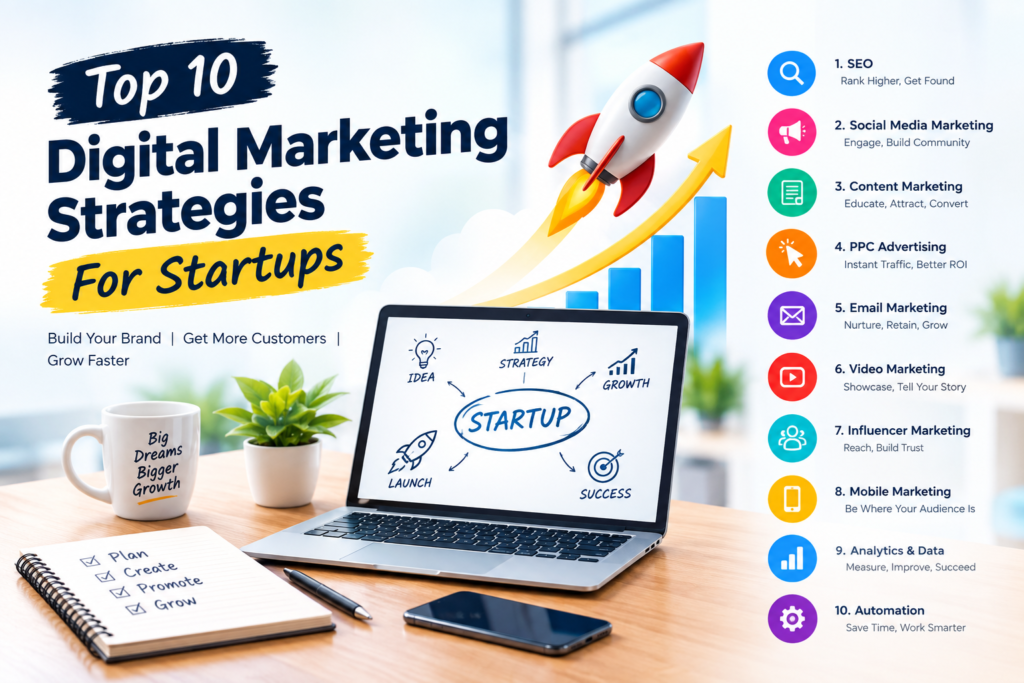
Starting a business is exciting, but getting your startup noticed in a competitive market can be challenging. With limited budgets and resources, startups need marketing strategies that can generate visibility, attract the right audience, and support sustainable growth.
This is where digital marketing strategies for startups become essential. From search engine optimization and social media marketing to content marketing and paid advertising, digital channels give startups multiple opportunities to connect with potential customers.
In this blog, we explore the top 10 digital marketing strategies for startups that can help build brand awareness, generate leads, increase website traffic, and create long-term business growth.
Why Digital Marketing Is Important for Startups
Digital marketing allows startups to reach potential customers where they spend a significant amount of their time—online. Unlike many traditional marketing methods, digital marketing provides multiple channels for targeting specific audiences and measuring campaign performance.
A well-planned digital marketing strategy can help startups:
Build brand awareness
Reach a targeted audience
Generate qualified leads
Increase website traffic
Improve online visibility
Build customer relationships
Measure marketing performance
Scale marketing campaigns over time
The key is not to use every digital channel at once. Startups should identify their target audience, business objectives, and available resources before selecting the right marketing channels.
Top 10 Digital Marketing Strategies For Startups
1. Build a Strong SEO Strategy
Search Engine Optimization (SEO) should be one of the core digital marketing strategies for startups. SEO helps improve a website's visibility in search engine results and can attract people who are actively searching for relevant products or services.
Start by conducting keyword research to understand what your potential customers are searching for. Optimize important website elements such as page titles, meta descriptions, headings, URLs, images, and content.
Startups should also focus on technical SEO, website speed, mobile usability, internal linking, and high-quality content.
A consistent SEO strategy can help a startup build organic visibility without depending entirely on paid advertising.
2. Create High-Quality Content
Content marketing is another effective way to attract and educate potential customers. Instead of simply promoting your products or services, create useful content that answers your audience's questions and solves their problems.
Startups can publish:
Blog posts
How-to guides
Case studies
Industry insights
Videos
Infographics
Checklists
E-books
Frequently asked questions
For example, a digital marketing startup could publish articles about SEO, Google Ads, social media marketing, and lead generation.
High-quality content can support SEO, establish expertise, and provide valuable information throughout the customer journey.
3. Use Social Media Marketing
Social media provides startups with an opportunity to build communities and communicate directly with their target audience.
Choose platforms based on where your customers are most active rather than trying to maintain a presence on every platform.
Create a consistent content plan that includes educational, informative, entertaining, and promotional content.
Some useful social media content ideas include:
Tips and tutorials
Customer stories
Short-form videos
Behind-the-scenes content
Product demonstrations
Industry updates
Polls and questions
Testimonials
Social media marketing can also help startups understand audience interests through comments, messages, shares, and engagement.
4. Invest in Google Ads and Paid Search
SEO can take time to generate significant organic visibility. Paid advertising can provide startups with another way to reach potential customers who are actively searching for specific products or services.
Google Ads can be used for search campaigns, display campaigns, video campaigns, and other advertising objectives.
Startups should create campaigns around carefully selected keywords and relevant landing pages. Track important metrics such as clicks, conversions, cost per lead, and return on advertising spend.
Rather than spending heavily from the beginning, startups can test smaller campaigns, analyze results, and gradually optimize their advertising strategy.
5. Develop an Email Marketing Strategy
Email marketing remains a useful channel for nurturing leads and maintaining customer relationships.
Startups can build an email list through website forms, lead magnets, newsletters, webinars, and other relevant offers.
Instead of sending the same message to everyone, segment your audience based on factors such as interests, customer stage, or previous interactions.
Email campaigns can include:
Welcome emails
Educational newsletters
Product updates
Special offers
Case studies
Event invitations
Follow-up campaigns
Personalized and relevant emails can help move potential customers from awareness to consideration and eventually toward conversion.
6. Optimize Your Website for Conversions
Driving traffic to your website is only part of digital marketing. Your website also needs to turn visitors into leads or customers.
A startup website should clearly communicate:
What the business offers
Who it serves
Why customers should consider it
How visitors can take the next step
Use clear calls to action such as Get a Quote, Book a Consultation, Request a Demo, or Contact Us where appropriate.
Make sure your website is mobile-friendly, easy to navigate, fast-loading, and trustworthy.
Landing pages should also match the message of your advertisements and campaigns. A strong connection between an ad and its landing page can create a smoother user experience.
7. Leverage Local SEO
For startups serving a specific city or geographic area, local SEO can be particularly valuable.
Optimize your online business information and create location-relevant content where appropriate. Keep business details such as your name, address, phone number, and operating information accurate and consistent.
Startups can also create location-focused service pages and content that answer questions from customers in their target areas.
For example, a digital marketing agency serving businesses in Mumbai could create useful content around digital marketing services for Mumbai-based businesses.
Local SEO can help startups become more visible to people searching for relevant services in their area.
8. Use Video Marketing
Video has become an important part of modern digital marketing. Startups can use video to explain complex ideas, demonstrate products, introduce team members, and answer customer questions.
You do not always need expensive equipment to get started. A smartphone, good lighting, clear audio, and useful content can be enough for many formats.
Consider creating:
Product tutorials
Explainer videos
Customer testimonials
Educational videos
Short-form videos
Frequently asked question videos
Behind-the-scenes content
Repurpose longer videos into shorter clips for different social media platforms and content channels.
9. Build Trust Through Reviews and Social Proof
Trust is especially important for startups because new businesses may not yet have a long track record.
Customer reviews, testimonials, case studies, certifications, portfolio examples, and measurable results can help communicate credibility.
Encourage satisfied customers to leave honest reviews on relevant platforms. Display genuine testimonials on appropriate website pages.
Case studies can be particularly useful because they explain the problem, solution, and outcome in greater detail.
Avoid exaggerated claims. Focus on authentic customer experiences and clearly presented information.
10. Track Analytics and Continuously Optimize
One of the biggest advantages of digital marketing is the ability to measure performance.
Startups should define key performance indicators (KPIs) before launching campaigns. Depending on the business objective, these could include:
Website traffic
Leads
Conversion rate
Cost per lead
Customer acquisition cost
Search rankings
Email engagement
Social media engagement
Sales revenue
Use analytics and advertising data to identify what is working and where improvements are needed.
Digital marketing should not be treated as a one-time activity. Test different messages, creatives, landing pages, audiences, and content formats, then use the results to improve future campaigns.